Friday, August 26, 2016

An emotional breakdown, averted, in three parts: Part 3

My handwriting was unusually neat. 


I typically write in a careless, unreadable scrawl that says "I might have a neurological disconnect between my brain and my hand." It makes love notes written by me less cute and more murderous, in a "maybe I wrote this by the light of the moon while perched in a tree outside your window, that's why it's so sloppy" kind of way. Once, I drew an adorable picture and wrote a note to send with someone on a plane. When he finally opened it up on the plane to read, the guy next to him asked, "Goodbye note from the kids?" That's a true story. 


Yesterday's handwriting though was a careful mix of cursive and print. The cursive said "I don't have time to pick up my pen, I've got things to say!", while the print said "I'm not so pretentious as to use only cursive. (Also, lowercase b's are hard.)"


I thought that, if my handwriting was neat, my thoughts would be neat too. That the words would know I was trying to take care of them, trying to treat them well, trying to make sense of them and to free them onto paper. I thought that the nasty, scary, mean words that I wanted to write (mostly aimed at myself), wouldn't seem so awful if they looked nice on the page. The spiky 't' in the word 'guilty' (as in, "I feel guilty that...", a common phrase I write in my journal) would look less like a cross that I was martyring myself upon if I made sure the proportions of the letters were pretty and the 'y' next to it was more loopy and less pointy.


Did the shape and curls and slant of my letters really have the power to make me feel better? Obviously not. But, in taking time to write (rather than scrawling the first words that came to mind), I described my feelings in a thoughtful, careful way.


By the time I ended, I had written five pages, my feelings broken down into six numbered categories. Just as I learned in the movie Inside Out (shout out to the 9-year-old who made me watch it while babysitting him and then chastised me for crying!), no one feeling existed alone; each was twisted intricately with another. "I am excited that..." gave way two lines later to "but it also scares me because...". Somewhere down the page "I'm so disappointed in myself for..." carried on seamlessly into "at the same time I recognize how great it is that..."


Every bit of loneliness I've felt this summer has allowed me to feel gratitude for moments of connection and laughter. Victories in being able to communicate (in rudimentary Arabic! in long-forgotten Chinese!) are more joyful because I was certainly struggling just the day before. Sadness over missing my family reunion this summer reminds me how lucky I am to have a family reunion on the calendar every single year. Scraped knees, lost keys, wet bags, overpriced food, traffic jams, and stomach aches, when put into perspective, are small inconveniences for all the blah, blah, blah rewards of travel. 


And I don't say blah, blah, blah because I'm out of touch and unable to recognize the privilege of travel. I say blah, blah, blah because, again, I'm having trouble putting into words all that I feel right now about the blessing and challenge this summer has been. I feel like I'm going to cry, again, but this time out of happiness. 


The emotional breakdown I warded off yesterday was born out of frustration and brokenness and guilt. It was avoided out of recognition that (a) I'm only human, (b) my feelings are justified, and (c) I can only let myself be affected by those things that I can control (which is very little). 


When I finally closed my notebook and placed it back in my bag, I stood up to find the heavy weight was gone (though, to be fair, I'd lost a lot of blood to mosquitoes in the last 45 minutes, so maybe that's why I felt lighter). I walked with a bounce in my step and smiled at the woman who had finally finished slurping her noodles. I walked and wandered and found myself on a street I'd heard of but never visited. I took in the neon lights and thought about how Beijing has changed since I was here in 2010 (babies wear diapers now! you can buy tampons anywhere!); I thought about how I had changed since I was here in 2010 (uhhh... a lot! more than I can easily write in two exclamations!) Tiananmen Square loomed before me and I shuffled along with a crowd of people, dodged selfie sticks, and marveled at how so much of my summer, left up to chance and prayers, had fallen into place. 


The emotional breakdown that I know will come on September 12th (and 13th and 14th, probably. really, as long as you'll indulge me), will be born out of gratitude: immense, inexpressible, all-consuming gratitude. Gratitude for people who have walked beside me this summer, who have emotionally and physically supported me, who have listened to me on FaceTime for hours on end, who have opened their homes to me, who have given me their beds, who have read my words and sent messages of encouragement, who have asked about me and sent well-wishes through my loved ones. That emotional breakdown will be born out of exhaustion - from living out of a backpack and walking everywhere (in order to save money for pastries) and from sharing a room with strangers: strangers who became great friends and strangers who snored a lot and remained strangers. That emotional breakdown will reflect my sadness that the summer is over, my happiness to see friends and family again, and my immense disbelief that I'm actually starting grad school (and terror that I'll be the stupidest one in my class.)


That emotional breakdown will be welcomed, with relief, because it feels good to feel everything. That's how I know I haven't taken anything for granted. 

An emotional breakdown, averted, in three parts: Part 2

Every nasty thought and unhappy sentiment and confused opinion and unsubstantiated anger and unrelenting joy that I hadn't felt in days suddenly broke some dam in my mind and flooded my brain. I couldn't physically take another step under the weight of the thoughts that were exponentially growing in my mind. I needed to release them somehow; I needed to sort through them and understand them and uncover why I'd felt so lost all week. 


I was walking alongside a small park just then, a place I'd run through before. There were large, polished boulders carved to look like birds and a thin row of hedges that just dampened the sounds of eight lanes of traffic flying past on the other side. I perched on the largest of the stone birds,a red one, and pulled out my notebook. Fittingly, I'd run out of journal pages just the night before and had already anticipated using my work notebook as a temporary journal for the last 18 days of travel.


There was a couple behind me on a bench; the man stared blankly out at people rushing by on their way home from work and the woman performed a tiny, tasty version of STOMP with her chopsticks and a bowl of noodles: click, click, slurp, sniffle. click, click, slurp, sniffle. 


With pen dangling over the page, I waited for words to come. I knew that if I could put all the thoughts and emotions swarming around my head into coherent sentences, and if I could get those coherent sentences onto paper, I could be free of them. But keeping my head above the roaring waves of my thoughts was hard enough; forming coherent sentences seemed impossible. 


So, I imagined taking my hands into my own hands, and crouching down to look into my own green eyes, and employing my best 'nice teacher' voice to tell myself, "I know this is hard, Kelly, but you need to use your words." And, employing a strategy I'd taught myself back in Peru when I was in the midst of a particularly confusing day, I began to disentangle and name my feelings.


"I feel frustrated because..."

"I am confused about..."

"I'm excited that I..."

"I'm so grateful to..."

"I'm a little sad that..."

"I feel guilty because..."

And on and on.


I've written in a journal almost everyday since November 1, 2012, the day I moved to Peru. That's over three and a half years of chronicling everything from the trivial to the life-changing. When I'm particularly busy, I might find that I go a week without writing, but then I'll force myself to jot down a little something from each of the days that I missed. Even if don't write everyday, I write something about (almost) every day.


I thought it would be good to hold myself accountable to daily reflection: I would recount a small victory or cherish some beauty or relive a moment of celebration. "[That student who is typically a tyrant] actually participated today, he loved the game and hugged me after class!" or "Amazing dinner with the community tonight, so much laughter over Allie's story, then we practiced Olympic race walking in the kitchen." Making myself recognize at least one great or powerful moment in the day did have the ability to transform my thinking. I might still go to bed with my head racing from the things I'd done wrong that day or concentrating on the epic "To Do" list of the next day, but somewhere in that burdened mind, there was a tiny, glimmering star of gratitude.


But I've gotten away from that more and more. My accounts of each day have moved towards a list of things I accomplished, or an account of how I spent my hours being productive (or unproductive) rather than an account of how I felt or what I learned.


Most of the time, it's something like: "Had a good run, nice sunrise, lots of people out. Went to work - finished the spreadsheet! Boss was impressed. Played frisbee, ehhhh, I didn't play well but the team won. So tired... why am I still awake at 1 AM?" Nothing too thrilling. 


When I read back through my journals, there are some gems in the laundry list accounts of each day. The fact that I was writing mere bullet points in a stream of consciousness style made the pronouncements I wrote all the more hilarious. "Got accepted to Stanford!!!!!!!!" was sandwiched between "food poisoning, felt like dying all morning" and "bathroom is so dirty again. passive aggressive note time?" Sometimes I sounded like a teenager in a Judy Blume novel. "Caught up with Alisha for over an hour. She's the best, great advice as always. I love her so much!" 


My journal is also riddled with phrases about someone who, luckily, finds my emotionally-distant commentary endearing. (Including what I wrote after our first date: "he's not as cute in person or as tall as I thought he'd be, but we had great conversations." I don't think that anymore, for the record. He's adorable and 6 feet tall, but I can't take it back entirely...  I wrote it in pen.)


Ninety percent of the time, my journal is a blubbering mess of sentence fragments and scrawled commitments to "not eat so much junk food" and "get more sleep!" Five percent of the time, my journal is home to quotes from books or accounts of really strange dreams I had the night before. The last five percent of the time, though, that journal is the only thing preventing me from bursting into tears and wandering barefoot around a gas station searching for ice cream. Not that I don't eventually cry and/or eat ice cream. It's just that, in my unyielding perfectionism, I force myself to finish writing in my journal before I'm allowed to attend to the rest of my imminent emotional breakdown.


Unsurprisingly, by the time I've finished writing, I typically find the distress has subsided, the constriction in my chest has eased (but the desire to eat ice cream remains). It's why I won't ever let anyone read my journals: there are nasty, judgmental, and rude things written about a lot of people and situations. I might feel those things momentarily, but, the second I've written the thoughts down, I can release myself from being manipulated or affected by them anymore. It's cathartic. It's also horrifying to imagine anyone ever reading them. (Please burn my journals when I'm gone. You will find no sketches of fantastical futuristic machines, or the secret ingredients to a family recipe, or clues that may lead you to buried treasure; burn the journals.)


So, I kept asking myself, "And how does that make you feel?" and I kept naming my feelings. I was almost okay again. 

Thursday, August 25, 2016

An emotional breakdown, averted, in three parts: Part 1

I felt nothing. It suddenly occurred to me that I felt...nothing. 


My eyes scanned the screen feverishly, barely taking in words I'd read 100 times before. I felt no excitement that, in just a few minutes, I would be submitting the final draft of the case study I'd been editing for a week; no nervousness to have my supervisor finally read it over; no pride in what we'd all accomplished this week. 


Even the peach I ate had no flavor. I was barely aware of the rhythmic motion as my left hand traveled from plate to mouth, plate to mouth. I looked at the knife I had just used to cut the peach. "I bet if I stabbed this directly into my thigh, even then I wouldn't feel..."


- Hold up. I was not thinking that.


Still, I felt vaguely numb and unimpressed, detached from the work in front of me, Work that, just hours before, I had enthusiastically explained in an email to my parents. But my enthusiasm hadn't just dwindled as I poured over online grammar manuals to make sure my footnotes were formatted properly, my enthusiasm had been dramatically and suddenly snuffed out, replaced by exhaustion.


I can't think of a time in the last 82 days when exhaustion wasn't one of the top three emotions I felt at any given time. Excitement, exhaustion, and gratitude. Or confusion, exhaustion, and mild nausea. Or exhaustion, frustration, and guilt (over feeling exhaustion and frustration). My life and travels and work this summer - in Greece and India and Nepal and China - have been so unpredictable, weird, and amazing, yet my emotional range seems to have shrunk to mimic that of Ron Weasley, aka, the size of a teaspoon.


Multiple times in the last few years I've had the paralyzing fear that travel has somehow messed up my ability to function as a regular, empathetic human. I've become far too competent at saying goodbye; I've developed a suspicion of strangers and situations that allows me to feel safe most of the time; I'm no longer shocked by even the nastiest, most sexist comments I hear; I absorb information about "the number of indigenous Peruvians killed by conquistadors on the ground where you now stand" and "the persistence of the caste system in India that affects people's perceptions of their own abilities" in an academic, almost robotic way, without letting the full weight of those words and moments and locations unsettle me as they should.


How can seeing more of the world make me feel less? 


It's as if I were preparing to run a marathon and my feet refused to cooperate. Imagine - lungs, quads, hamstrings, calves, brain, and heart - conditioned to carry me 26.2 miles, but feet that sprout blisters after just two. 


The endurance I'd built for marathon travel - to survive on barely any sleep, to lug around a backpack filled with increasingly malodorous clothes, to stay in a new hostel each night with a hodgepodge of international characters, to scrounge in grocery stores for any healthy food, to ride in the back of jeeps and trucks, to never be certain what the day would hold - had stopped just short of my heart. I can only feel so much at one time (whether it be pain, confusion, sorrow, or joy). Sometimes, in marathon-travel moments of overwhelming stimulation, I shut down. My other senses work, but my ability to process those experiences and all that's bombarding my eyes and ears at any given moment ceases to function. "I'll figure it all out later," I think. "Right now, I need to get through this." 


Yesterday, after scanning the same 40 pages for hours and hours, I finally finished proofreading the document, attached it to an email, and hit send. My supervisor gave me a wave from her desk and then swung by my desk a minute later to say thanks and to tell me to take a break. She'd add in some of the graphics and charts after they were translated from Chinese and we'd work on formatting the final document in a few days.


I left the office two hours later, having accomplished nothing else that afternoon. I'd mostly sat at my desk and read about "Weekend day trips to escape Beijing" on TripAdvisor, without feeling particularly excited about any of them.


I was walking back towards my hostel, debating whether I should go wander around Houhai for a few hours, or if I should do some grocery shopping, or go sit in bed and study Chinese. I felt disinterested in all my options and wondered if 7 PM was too early to go to bed.


Suddenly, I felt like I was suffocating:
I could feel everything.

Sunday, August 21, 2016

Titles Under Consideration for my Unwritten Travel Memoir

Oh The Places You'll Go (to the bathroom, without shame, because it's not your fault you have diarrhea)


Everyone Poops, just sometimes it's in a trash can in Tiananmen Square*
* I swear this wasn't me. It was a seven year-old Chinese girl.**
** Mom, I promise it wasn't me. I would own up to it.


Just Act Like You Belong Here and No One Will Realize You're Not a 90 Year-Old Chinese Man


How did I not learn to drive a car with manual transmission? (And other ways my parents let me down)*
* This would not be a book, just a one-page diatribe on the only way my parents have ever failed me.


Kelly, You're Still a White Girl, Even When You're Tan


Travel Hacks: Avoid Getting Robbed by Owning Really Shitty Things


Travel Hacks: Avoid Unwanted Attention by Refusing to Bathe or Do Laundry


A Solo Female Traveler Safety Guide:
(Or: Why it would be so much easier to be a dude so no one bothers you and you can feel safe and sheltered from the realities of what women around the world face in their daily struggle to exist in this world!)


"Don't Get into a Car with Strangers" and other advice I followed as a kid in Illinois but somehow forgot as a 20-something year-old in Bolivia


There Are No Stray Dogs in China (actually, not a memoir title, just a recent, concerning revelation)


But the rabies shots were free!
Finding the silver lining everyday


Damp: A Chronicle of Traveling in Asia During Monsoon Season and South America During Carnaval


Those aren't sprinkles! Dealing with Disappointment (like eating candy-coated fennel seeds in India)


Oxygen Deprivation: Cheaper than Cocaine or Ayahuasca
(Also, Is this normal or is it an aneurysm: Hiking in the Andes without proper altitude acclimatization)


Alcohol Kills (the parasites in your stomach, maybe, so go ahead and drink instead of taking antibiotics)


"Soy vegetariana, No, no como pollo." and other fun phrases for when you're served a plate of cow stomach or a skewer of starfish*
*Note: recognizing the animal and body part you're about to consume is a delightful rarity!


"This is the quintessential (insert foreign country) experience."
Lies we tell ourselves on overnight bus rides and in other moments of misery


If they think you're Dutch, thank them; if they think you're Russian, be concerned.


Cultural Exchange For Dummies
The definitive rules of East Coast beer pong!


Emotionally distraught or just eating spicy food? Either way: Ice Cream!
How to cry in public and cope with a quarter-life crisis at home or abroad


The Audacity of Nope: When your banner of "I preach and live cultural acceptance!" gets tangled


I Can't Even. I Literally Can't Even.*
*The aforementioned book ("The Audacity of Nope") about the struggle to reconcile your desire to be culturally sensitive with your awareness of social injustices, but for millennials! With ten social justice-inspired adult coloring book pages, like that dead Syrian boy on a Greek beach. Also includes three metallic tattoos of the words "Solidarity", "One Love.", and "Bye Felicia!"


Open your eyes: change your heart
Open your mouth: change the microbial biome of your gut in permanent and irreversible ways


Why do most of my memories involve poop? (Both a potential memoir title and a real question I ask myself most days. Does anyone else have a photo album on their computer called "Beautiful scenery I've had the pleasure to look at while squatting on the side of a hiking trail"?)

Thursday, August 4, 2016

Greece

"The camp is much nicer than I thought it would be!" a family member commented after seeing a picture I shared of Ritsona, a refugee camp where I was volunteering in June. 

I balked. Much nicer? This was a terrible place to be! Couldn't they see that?

Within a few minutes, though, the shock of the comment subsided and I realized I agreed. The neat rows of tents in my photo (I hadn't wanted to take pictures of refugees) didn't seem that bad, at least not compared to what I expected it to be.

When my friend Meghan volunteered in camps earlier this spring and came home telling me heartbreaking stories of her time there, the refugee crisis was still a state of emergency. Patrols monitored the narrow channel between Turkey and Greece around the clock and pulled refugees onto the shore. Meghan told me about the chaos of food, water, and clothing distribution, the emergency medical care being provided for everything from torture wounds to sea anemone gouges to crippling dehydration, and the panic of the refugees as they frantically sought answers and wondered when they could leave for Western Europe. Between the stories she told me and the constant images I saw on the news, I had become desensitized to what the refugee crisis was supposed to look like: visible pain and suffering and the rapid, heroic responses of hundreds of good-hearted volunteers.

By the time I arrived in June though, the crisis was changing, which meant both the needs and the suffering were changing too. An EU-Turkey deal had temporarily closed the borders. Despite what may have been communicated in the international news, violence was not abating in Syria and refugees were still fleeing by the hundreds and thousands to Turkey. There, they waited in camps along the western shore and looked out across the water to the visible peaks of Greece's Lesvos island. But in Greece, the situation was less urgent. 

The Greek government, military, and hundreds of non-profits were focusing less on emergency relief and more on long-term care. Conditions and amenities differed wildly across camps, but some of the long-term solutions included running water, banks of portable toilets, plastic-sided cabins instead of fabric tents, electricity, library spaces, education spaces, female-friendly spaces, medical clinics, and cooking stoves. Although most places still had a very ad-hoc organization to them, the Greek military was beginning to consolidate its authority and organize the duties and responsibilities of each non-profit. The conditions and needs shifted rapidly, the tensions and moods of people fluctuated, and relationships between non-profits varied day-to-day, but the overwhelming sense was one of increased permanency and stability.

When I took the aforementioned photo, it was a quiet morning. Most of the residents of camp were still sleeping - it was Ramadan after all. The observant Muslims who were fasting during daylight hours liked to stay up all night to eat heartily and enjoy the cool air. As I wandered around camp at ten in the morning, I encountered still-closed tent flaps, their occupants sleeping soundly inside. Shoes in front of each tent were in tidy rows or heaped in bins, laundry hung motionless on lines strung between tent poles, and rubbish from the day before had been picked up by bands of kids sometime during the evening. Maybe it didn't look nice, but it looked humane. 

No, the atrocities so many, myself included, envision when hearing about the refugee crisis - like the forgotten body of a tiny child washed up on a Greek beach - weren't visible in my photos. 

I didn't photograph the forty portable toilets used by the camp's 800 or so residents, nor the ten showers they shared, or the six taps for running water. I didn't photograph the pits where women squatted in the sand, chopped vegetables with blunt knives, and cooked over open fires each day. I couldn't capture the heat of the Greek summer sun turning the tents into saunas and making the walk to the toilets - across a huge, exposed concrete slab - into a painful march. I didn't photograph the lines of people queuing up for breakfast, lunch, dinner, and drinking water distribution, nor did I photograph adorable young kids struggling beneath the weight of watermelons and water bottles and cartons of food: struggling, but still eager to help their parents. I couldn't share the smell of heaps of garbage and leftover food rotting in fly-swarmed piles and the stench of hundreds of people living in close quarters. I didn't record the sounds of crying babies who were too hot to sleep or the shouts erupting across camp as tiny skirmishes broke out between residents on a daily basis. 

And, still, the atrocities and suffering gets worse. 

There's a permeating sense of hopelessness and restlessness. After 4 or 5 weeks of intense travel across Syria and Turkey (and sometimes from even farther), the refugees now sit in camps and wait. There is no more running or escaping or hiding, only waiting in lines and filling out paperwork and waiting some more. 

They've been in these camps for 3-6 months now and won't realistically get registered with the Greek government to get their asylum papers for a long time. The refugees know this: they know it could takes months or years for the thousands of them scattered across Greece to be registered; the pregnant women know their babies will be born in these camps, the babies' first steps taken on rocky campground; families know they won't be reunited with loved ones who went to Germany or Italy before them for a long time. And there's truly nothing they can do to make the registration go faster.

Then there's a feeling of boredom and uselessness. These people were teachers, lawyers, craftsmen, scientists, university students, and so much more. They now have nothing to do but sit around idly, the lack of autonomy and capacity crippling their once vibrant sense of purpose. When they did have access to spare wood to build benches or tables, they threw themselves happily into the work. Despite the heat and lack of diverse ingredients, women embraced the opportunity to cook for their families: the chance to hold on to some shred of their traditions and their dignity was a welcome distraction. When donated clothes or food or supplies needed moving, most residents were anxious to help the foreign volunteers; they wanted to contribute and to earn what they were given. I witnessed no presence of entitlement.  

While young kids ran wild underfoot, enjoying the perennial feel of being at summer camp, the older kids spoke sadly of the homes and friends and schools they'd left behind. More than anything, they missed their education because, already at a young age, they appreciated the privilege of education. Many had stopped going to school during their last few years in Syria because schools were major targets of bombings; for some, it had been three years since their last time in a classroom. University-age students recounted how close they'd been to graduating - some just a semester or two away - when their families decided to leave. They knew the journey to get their university degree, if they were able to get into and pay for school, would require many more years. And, yet, they all expressed their relief to not live in constant fear. 

I feel a need to mention here, should anyone reading think the refugees take for granted all they are receiving for free: they do not. There's an enormous sense of gratitude for the food, shelter, and services they receive. They are grateful that they, for the most part, are safe. (Though violence and crime absolutely do exist in the camps, especially against women.) They are happy to be out of Syria, Afghanistan, Iran, Iraq and many more countries where they didn't have a future. And to the critics who say, "Well, they chose to leave. How can they expect to be immediately welcomed into a new country?" I respond: they don't see their decision to come to Greece as a choice. They see it as the only option for their survival, and they know they are fortunate to have survived thus far. 

They are grateful and safe, yes, but they are not without frustration. They wonder why the borders are closed and when they will be reopened. They wonder why European countries are refusing to take in any of them. They wonder how people can be so xenophobic and cold when the refugees just want to be free from violence. They wonder why the international community didn't intervene to save their countries before they were destroyed. 

They tally their dead relatives lost to the Taliban and to ISIS in shockingly neutral tones, hardened by years of violence. They ask when they'll be allowed to formally request refugee status. (Trust me: they want to do this legally.) They express gratitude for the Greek people for sharing their land and resources. They profess their adoration for Germany and how much they truly want to assimilate into Germany, or wherever they're sent; they're not asking for a Syrian enclave. They constantly state that "Syria is dead" and "Syria is no more" and that they know they'll never be able return to the country of their birth, as if stating these awful truths will make it easier to believe. They mention they're surprised I'm there: they didn't think Americans cared at all. 

And along with the helplessness and restlessness and frustration and sadness, there is tension. Rumors swirl about smugglers who will take families to Germany for $5000 a person; some refugees suspect that Syrians get better treatment or are more likely to get asylum than people from other countries; In some camps, certain refugees leverage favorable relations with local Greeks and volunteers to get more food, more clothes, or more information. 

Though most of these tensions are based on rumors, tensions become shouts which become physical fights. Most of the skirmishes I saw were small, but there were some bad fights and attacks against entire families; families had to be moved out of the camp and to new ones on a few occasions. I saw a fully grown man pulling the hair of a 12 year old girl, who wasn't his own daughter (not that that would have made it ok), and beating her arms while about 15 people stood and watched. As far as I know, there were no consequences for the man. 

And, seeing and hearing about the suffering and boredom and waning hope made me feel as if what I was doing there was so inadequate. I was barely doing anything compared to what needed to be done! I had to constantly remind myself that I was there to learn, observe, bear witness, and contribute in any way I was asked, not there to be a savior or to fix something in just four short weeks. I trusted the missions of the organizations with whom I was volunteering, as these organizations were there long-term and had experienced staff members (and financial backers) who could ignite change.

In Ritsona (just outside Chalkida, Greece), I worked with Lighthouse Relief in their female-friendly space. We provided a safe, fenced-in area for girls over 13 (and little babies if the mothers brought them inside). We provided supplemental nutrition for pregnant and nursing women, a small air-conditioned space for breastfeeding and relaxing, and sanitary baby bottles and formula for mothers who didn't nurse. I also ran a daily English class for a small group of devoted women and tried teaching yoga, but they were fasting for Ramadan and were too exhausted. We did art projects, watched the babies so they could rest, and focused on creating a safe and inviting space. It was very special to be a part of that team and to hear the incredible and terrifying stories of the brave women I met.

Then I traveled to the island of Lesvos, the island that has received most of the refugees, as it's just three miles from Turkey across the channel. There I worked in a place called Kara Tepe with two Dutch organizations: Because We Carry and Movement on the Ground. This camp was more established than Ritsona, as it has existed since last September and Ritsona was opened in March. The camp residents were also more diverse (Syrians, Iraqis, Iranians, Afghans, Congolese, and Nepalis). With a crew of vivacious Dutch friends (who also let me live with them) we were in charge of preparing and distributing breakfast for 660 residents every day. Because of Ramadan, we prepared the meals in styrofoam containers in the late evening, then distributed them to the fasting residents in the middle of the night. After a few hours of sleep, we returned to camp in the morning to distribute the rest of the containers to non-fasting residents. The organization had opted to hand deliver the breakfast containers and fresh fruit to each tent to avoid the stress and potential conflicts born of food-distribution lines. I enjoyed delivering the food, as I got to know the residents in my section of tents and dawdled with my deliveries so I could hang out with them more. Our final part of the day was to play games and sing songs with the children for a few hours; the kids especially loved water balloons and their parents loved a few hours of rest. 

Besides the incredible interaction with refugees and the opportunity to hear their stories and literally see the scars some bear from abuse and torture in their home countries, I learned so much about emergency management, the UN and its relationship with various governments and Greek government agencies, the Greek people's response to the crisis, and the interaction between organizations providing services. It's startling to see first hand the red tape and inter-agency drama that prevents goods and services from being delivered to the refugees. It's horrifying to see the amount of waste (of resources, of pre-packaged-food wrappers and containers, of human waste that must be carted off in sewer trucks each day, and of water.) At the same time, there is so much heart and love and good work happening as well. I truly believe that 99% of the foreigners and Greeks I encountered have the refugees' best interests at heart, but sometimes in-fighting and personal exhaustion and competition for scarce money and other resources leads organizations to bicker. 

I really loved all of the volunteers I got to know, from my French-Canadian buddy Vienna and the rag-tag AirBnb crew we accumulated to the quirky Dutch folks who sang show tunes to keep us awake in the middle of the night during our meal prep assembly line. I was amazed that these people - from at least ten different countries and two dozen different professions - had all wound up in Greece this summer. We all had our story of the moment we decided to come to Greece and, despite our diverse backgrounds, those stories joined together promised to destroy apathy and to spread compassion. 

I left Greece extremely aware of the cruel truth that I had just spent a month with people who can't leave. I left to adventure when the people I left behind were asking just to live. I left with freedom of movement when these people just want to be free from violence and constant fear and free to pursue their goals. I left knowing that, sadly, there's not much I can do alone to change their circumstances. Collective, political action will be the only way to improve their lives permanently. I left knowing that these people deserve better than what the international community has shown them thus far, and anyone labeling them as terrorists or leeches or pariahs needs to open their heart and read their stories.  


I left realizing that people who had witnessed more inhumanity than I could even fathom had shown me - a privileged outsider, a person who doesn't speak their language, and a person who was going to leave them - what it means to be truly human. 

Tuesday, August 2, 2016

Leaving, again.

Earlier this year I purchased a (somewhat fiscally irresponsible - more on that later) around-the-world plane ticket to travel to Greece, India, and China for 14 weeks. Unlike other trips when I've (obsessively and excitedly) planned out each day, I felt uncharacteristically unmotivated to research and plan for the summer. (Uncharacteristic for me, yes, but not unsurprising, given that saying goodbye and leaving the the US had suddenly become more difficult than ever before - more on that later). 

I sent some emails, joined some Facebook groups for volunteer organizations, and convinced myself that everything would work out just fine.  


Two days before my flight to Athens, I was sprawled out on a hotel room bed in Tampa (making a weekend pit stop to attend a wedding, a cocktail dress stuffed in my carry-on between mud-encrusted hiking boots), frantically purchasing international health insurance and messaging a French-Canadian girl I was supposed to meet up with in Athens, who I hoped was (a) not a psycho and (b) more prepared than me - supposedly she already had an AirBnb booked.


Every time I imagined boarding my flight on Sunday, my throat tightened and my heart raced. I had never before taken such a long trip alone. Past solo trips - to Bolivia, Chile, and Ecuador - were much-awaited times for self-reflection and 25 mile dawn-til-dusk hikes. Every long trip I'd taken, though, had always been with friends; the inevitable challenges and daily stresses of last-minute decisions seemed less daunting with them by my side.


I knew I was capable of doing this alone: my constant assertion for most of my life has been, "I'm an independent and strong woman, dammit!" (An assertion proclaimed with equal relish before training for an ultra-marathon on a shaky knee and before taking three shots of tequila on an empty stomach.) The more I was told by friends and family and strangers at REI what an inspirational, selfless, and tough person I was for taking this trip, the more I wanted to crawl into bed with a bowl of ice cream and watch Netflix.


Somehow, the last 16 months of my life since returning from Peru - living and working in Houston, Washington DC, Houston again, and Portland - had unnerved and exhausted me. Rather than fuel further wanderlust, I was finally craving stability: a place to live for more than 4 months, artwork hung with actual nails, an Ikea furniture set that wasn't a hand-me-down, a real mattress filled with springs instead of air, and hobbies. Oh, the hobbies I dreamed of!  Hobbies - like cycling and triathlons and gardening and heaps of volunteer work - that are best pursued when I call a house a home for more than one season change, and when disposable income no longer seems like a foreign, adult concept.


Then there was him.


But, I'm an independent and strong woman, dammit! Hobbies and artwork and him, they could all wait. Despite the feeling of emotional exhaustion and the acute realization that I was already burnt out, before I'd even begun traveling, I never considered not getting on that plane:

(1) I'd already bought the tickets. (cheap)
(2) I'd look like a failure. (proud)
(3) I'd regret not going every day for the rest of my life. (mellow-dramatic)      

Forty-eight hours of Tampa wedding fun later, I was locked in a bathroom stall at the Montreal Airport on the verge of a panic attack. I had no idea where I'd be sleeping the next night in Chalkida, Greece. I was sobbing over all the goodbyes I'd said, questioning my overzealous travel plans, and cursing myself for not being better prepared. ("I can't even say 'please' or 'thank you' in Greek!" I lamented. I downloaded an offline English-Greek translation app on my phone and felt a tiny bit better.)


I called him using the airport WiFi. "You're an independent and strong woman, dammit!" he said. (But not really. It was something more poetic and uplifting. Besides, if he had used my own line on me, I would have been pissed.) He told me I was inspirational, selfless, and tough, or something like that, which made me want to scream, "I'm not who you all seem to think I am! I regularly eat quesadillas despite debilitating lactose intolerance and I know way too much about Selena Gomez and Justin Bieber's ill-fated romance!" But I didn't actually scream that. We hung up.


I staggered around the Duty Free shops for a few hours with nervous energy bubbling up in the form of fresh tears every five minutes. I felt emotionally hungover; no, I felt actually hungover. I chugged water. My newly-hydrated tear ducts went to work again.  


I angrily wondered why no one - not family nor friends nor him - seemed to believe me when I told them I was a selfish, incompetent fool; they just insisted the opposite. I contemplated why no one else could see me the way I see myself: scraping by on mere adequacy and good luck. Eventually, I wondered, finally, with despair if I could ever see myself the way others see me...


Realizing that was far too profound of a thought experiment to undertake, I bought a pastry.


I boarded my flight (upgraded to first class for the first time in my life!) and watched The Danish Girl (at least my tears were no longer just for me) and fell into a fitful sleep.


And, thus, I arrived in Greece with weary bones and an aching heart and not a scrap of the excitement or gratitude I knew I should have.


Then I met Vienna, and she wasn't a psycho and she did have an AirBnb and, for the next 16 days, she and a rambunctious cast of characters became the most important people in my life (but more on that later).

Thursday, November 12, 2015

Is there a way to say "I'm not okay" without terrifying people?

*This is something I wrote about a month ago, during a mini-meltdown inspired by feelings of inadequacy, and the certainty that I would never be good enough to get into the grad schools that I want to attend. Add to that the sadness that I wasn't at Georgetown Homecoming, the acute awareness that I chose to live in Houston, so I had no right to complain that I disliked living here, the somewhat prevailing panic I feel from time to time that I am somehow incapable of making friends, and the desire to write down how I felt at my worst (because, if this is the worst I feel, then I am very, very lucky). When I was still in Peru, a friend of mine called me out for only writing about the easy, happy aspects of life there; he, who heard me complain more than just about anyone else, justifiably accused me of not giving an accurate account of our lives. What he said holds true a year later: if I want to give an honest portrayal of these ten months of transition, I owe it to all volunteers returning home to share the moments when I've felt most helpless and confused. Thanks, Pedro, this one's for you. 

I'm not okay, but that's not the same as saying that life is awful right now. This isn't a cry for help; there's no need to worry about me, to coddle me, or to walk on eggshells around me. It's not meant to be a grim statement.

I'm not okay, but I'm not scared of admitting that anymore. I'm learning to welcome the sense of vulnerability that comes with admitting - to myself more so than to others - that this long period of transition is wearisome. 

I'm not okay, but there is far greater suffering in the world and I'd rather spend my thoughts and prayers on Syrian refugees, victims of mass shootings and police brutality, and innocent bystanders of violence in the Middle East. My concerns and discomfort are so minuscule compared to the anxiety and fear that plague other people each day.  

I'm not okay, and, although others suffer far more than me, I also know that my feelings are legitimate and allowed. I can't feel guilty that I somehow lack solidarity and perspective because I too am having a rough time. 

I'm not okay, which just means that I haven't been my best self much this year. The beauty of that sentiment though, is that it means I've seen myself at my best and I know what I'm capable of when I feel happy and whole. I'm currently learning what I'm capable of when I'm almost happy and just a little roughed up around the edges - and I am still quite capable, which is a gift. 

I'm not okay, but I'm also not alone in feeling overwhelmed and uncertain. The beautiful and peculiar life I led in Peru and the transition back to life in the States is only partly to blame. I suffer from the self-imposed pressure to figure out what I'm doing with my life in order to stop living in 4-month increments, which I understand is shared experience among 20-somethings. 

I'm not okay, but I know I'm the only person responsible for my happiness, and I make choices each day that make me more okay. (And I've discovered there's a critical mass of grad school curriculum I can read each day before turning slightly psychotic.) 

I'm not okay, but I will be. Both a cheesy metaphor for life: "life is a roller coaster," and a famous literary quote: "It was the best of times, it was the worst of times," accurately describe how I feel right now as I try to simultaneously embrace both hope and frustration, gratitude and embarrassment, and confidence and timidity. 

I'm not okay, but I will be. It's not a battle cry, nor a mantra, but it's the best thing I have right now. 

Thursday, September 24, 2015

What do you want to be when you grow up?

A meditation on change, beginning at age five.

a monkey
a teacher
a beekeeper
an art teacher
an actress (on the Disney channel)
a singer
a professional soccer player
a dolphin trainer
Jane Goodall
an actress (on anything but the Disney channel)
an author
a National Geographic photographer
a teacher, high school math and social studies
a mountain climber
an ambassador
a politician
an international tour director
a secret agent
a documentary filmmaker
anything but a teacher (Dear Lord, teaching is going to kill me)
future president Hillary Clinton's secret service detail
an engineer
.
.
.
uncomfortable


That's what I want to be when I grow up: uncomfortable.

I don't mean physical discomfort - although no running water or electricity may, at times, be necessary byproducts of the life I want to lead. Nor am I aiming for elective suffering which is a privilege that only people who don't have to suffer can choose.

What I want is to embrace the discomfort of the inequality and injustices alive in our world, juxtaposed with the privileges afforded me by the color of my skin, my place of birth, and the income of my parents. I want this uncomfortable truth to drive me constantly to action and reflection. I want to surround myself with unapologetic activists, restless dreamers, and people who deserve to have opinions about hot button issues: people who can teach and inspire me. I need to accept the uncomfortable reality that, no matter how much I actively engage in downward mobility and accompany the poor, I can never fully stand in the margins.

I want to be idealistic, but realistic. I want to tackle more than I can handle, and fail, but not become disillusioned. I want my career path to meander through unexpected places. I want to seek ways to challenge myself and grow each time I get too comfortable.

And considering my life is planned out only for the next three months, I'm already doing a pretty good job at being what I want to be when I grow up.


Tuesday, May 12, 2015

Rediscovery: Collegiate Mad Libs


Most people, within twenty minutes or so of meeting me, learn that I´m a huge fan of games: Fish Bowl, Gin Rummy, Amish Telephone, Cards Against Humanity, Apples to Apples, Clue, Boggle... and the list goes on and on. However, the unfortunate ones who participate in game nights with me quickly discover that I can be a tad bit competitive (and cue a worldwide round of apologies to friends, family, and strangers). But I love Mad Libs because it´s not (supposed to be) competitive and it´s creative, mind-sometimes-in-the-gutter fun!

(Plus, I had wonderful, energetic teammates and long car rides to weekend frisbee and rugby tournaments in college, during which we pushed the boundaries of appropriateness with our Mad Libs fun!)

I spent way too long rereading the Mad Libs we wrote on those car rides. Here are some of my favorite lines:

"He should have a left buttock that´s not bigger than yours, hands as big as fists, and wenises that go on forever."

"You don´t know if it´s the turpentine or the soap scum, but you are beginning to feel sexy. You make your apologies and try to hump."

"He likes to tantalize computer games on it and has recently programmed it to devour to him in a voice that sounds like George W. Bush."

"(A pickup line) Your wenis must be real tired, because you´ve been jerking through my Bosnia all night long."

"(A deal breaker) Says ´Weeeeee´ when the two of you snuggle."

"He looks fit, but he´s a hypochondriac who makes ´Oh sock it to me´ noises just walking into the pub."

"All he does is blather on about how much he gyrates his job and how he has 7 friends and how his moist girlfriends are as nutty as mango and how his family kisses him."

"If his bush was on fire, these are the things your guy would grab as he´s screaming ´Oh hot damn!´ at the top of his lungs."

Saturday, May 9, 2015

Rediscovery: Middle School

I was happy: living an idyllic childhood amidst the bucolic cornfields of central Illinois, with little homework, and free from raging hormones.

Then I turned 11, moved to Florida, and gained an unhealthy dose of self awareness. I was suddenly keenly observant of the bodies, emotions, words, and grades of everyone around me. I existed in a dichotomy where it was okay to play with Barbie dolls, break out the dress up box when my friends came over, and wear Harry Potter costumes to book releases, but only if I deliberately did so as to not conform to the standards that dictated pre-teen life. Had I engaged in any of these nerdy, childish activities without demonstrated my understanding that they were, in fact, nerdy and childish, I would have been banished to an even less cool lunch table.


This was the era when a birthday party consisted of my four best friends and I eating as much cake as we wanted and not talking about how fat we thought we were. This was when my (slightly age-inappropriate) birthday gift of Truth or Dare Jenga made me laugh uncomfortably because I didn´t know what all the words meant, and I never wanted to admit that to my friends.


This was a time when girls still wore Halloween costumes that covered over 40% of their skin but friendships could be formed and broken in the span of a three-hour party.


This was an age when labels - of popular, unpopular, jock, nerd, teacher´s pet, bad boy, class clown, and so many more - were somehow magically distributed and, even more shockingly, magically left unquestioned. When who I stood next to in a group picture might determine, and did, my best friends for the next year. When a Limited Too shirt was essential to be considered cute but then, overnight and without fanfare, American Eagle and Abercrombie suddenly swooped in and upped the ante by demanding we all now be hott and thin. 


When people formed friendships that endure to this day, even though some friendships barely survived the 7th grade. When I met people I would never have guessed I´d still talk to. When we were all trying to figure out our place in the world.

When it was impossible for boys and girls to be friends without rumors floating around of a possible crush and, yet, my tight-knit group of Team C classmates (the school´s label, not ours) somehow managed to churn out amazing, creative group projects that were romance- and drama-free. 

When we passed notes filled with goofy doodles and compliments like, "I luvvvvvv ur shirt!" but were also preemptively mean and hurtful to friends, lest we be the ones ostracized from the group. When friends were finally observant enough to tell us what they liked and didn´t like about us. When I heard the critique, the first of many times I´ve heard it, that I´m intimidating and cold.

When I didn´t realize how much it would sadden me one day to realize I don´t remember all of their names and I don´t know where they are now.

When I once farted in class and blamed it on one of the girls below. (I´m really sorry. I´ve been waiting a long time to confess to that one.)


Middle School was a chance to let obsessions run wild. Like my obsession with TLC´s Trading Spaces. (Fun Fact: My one and only celebrity encounter, to this day, was the Trading Spaces designer Frank Bielec. He signed the newspaper article about him and told me I had beautiful eyes. I was literally rendered speechless.)
Or my obsession with World Vision that would lead me to raise money to build a school in Mozambique, influence me to study International Affairs at Georgetown, and inspire me to live abroad after college. And here I am, at 25, fulfilling my dream to work for them. It´s been a love affair with development work that, at age 11, made me want to grow up to "save the world" and, at age 25, leaves me wondering everyday if we can figure out a way to all save each other.


Or my obsession with the cutest boy in middle school who once wrote me a note telling me, "I like you a 6 out of 10," that made my heart beat wildly for days. This was a time when brushing shoulders and passing notes pushed the limits of my flirting abilities and when the thought of holding hands made my palms sweat.


Middle school was the time of our sexual awakening. Oops! Scratch that.

Middle school was the time when we were giggly over the fact  that FabergĂ© sounded more like a line of lingerie than a master jeweler of the Imperial House of Russia. And whispering the word "lingerie" was the closest any of us came to a sexual awakening in middle school. And I got this awesome, homemade birthday present: a faux instructional pamphlet on how to make my own "Fabraje´ Lingerie." (Fun Fact: the supremely creative friend who made this for me now works in the fashion industry in New York!) 


Middle school was awful and wonderful, as so many dichotomous things are. We were in a hurry to get out of there but scared of what was to come. We couldn´t wait to be in high school, but as soon as we stepped through those doors we, once again, had to figure out how to grow up right. And we did, eventually.  

Rediscovery: Childhood

I´m basically an adult now and it´s inevitable that I will soon move into my own apartment (which will probably be the size of a shoe box or shared with six other people or be in another country), but my impending independence means I no longer get an entire closet at my parents´ house to store 25 years´ worth of boxes. I spent the last three days carefully pouring through the notebooks, pictures, journals, letters, costumes, and random objects stored in that closet. I spent hours reminiscing about the memories, love, and weirdness that surround each object, remembering people who have passed through my life, and reflecting on the moments, both poignant and goofy, that have shaped me. 

I spent most of the last three days smiling and laughing as I uncovered unexpected memories. Here are just a few of them.

(Also, I have zero mirror selfie game and I can´t figure out how to take pictures without the camera covering my face. I´m pretty sure I need to study more physics to understand reflection better.) 

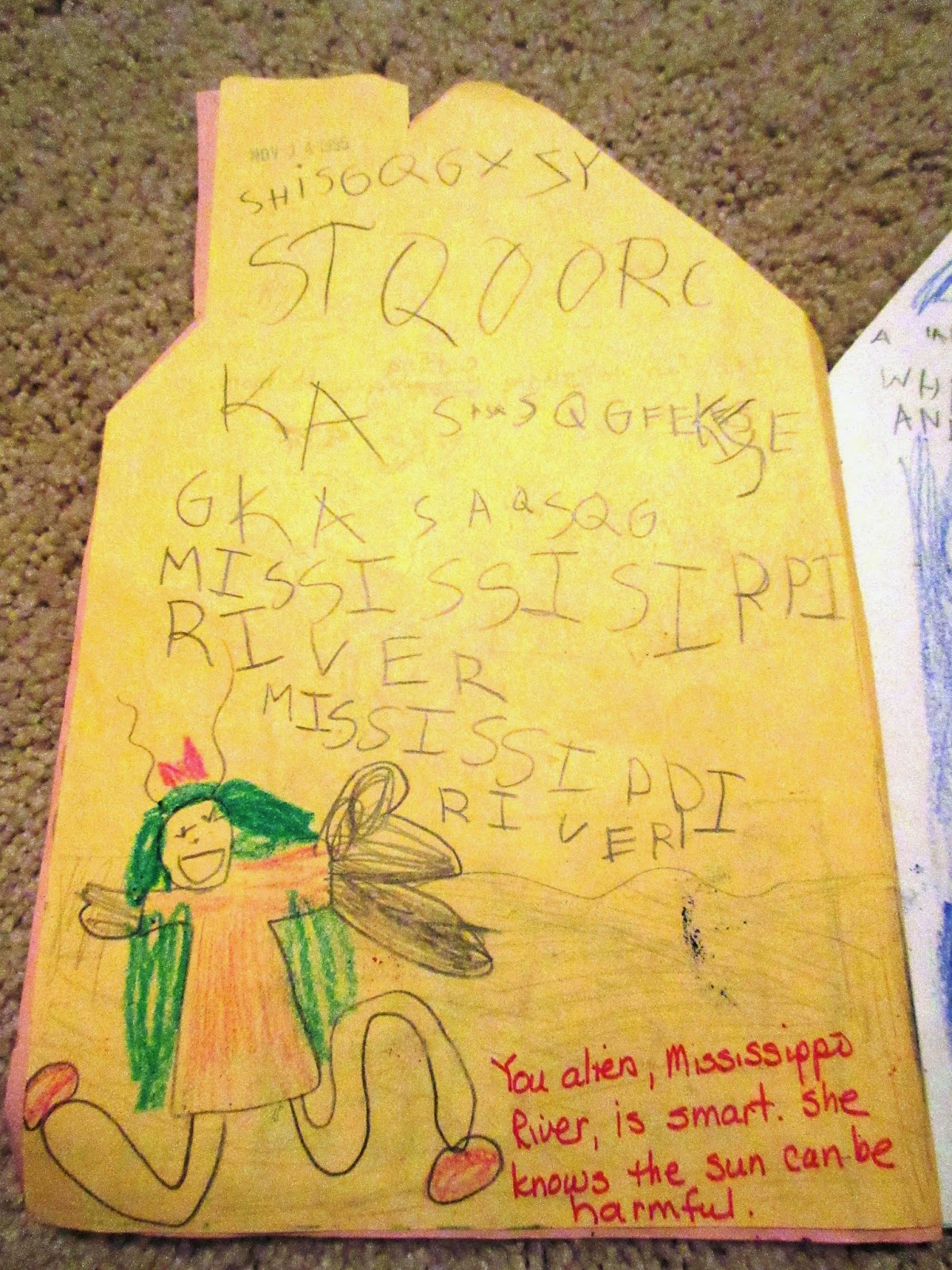
I was quite the story teller at five years old, but I had no idea how to write complete words.

My Daisy Troop - my mom was one of the leaders.
Check out the creative sweatshirts they helped us make!

Daisy arts and crafts at my house. Half of these girls are now married and
they´ve been bridesmaids  in each other´s weddings. Awwww!

My 4th grade teachers signed my autograph book.
Further proof of my lifelong role as a teacher´s pet.

Jenny, Hannah, Kelly, and Keelin at Fr. Sweeney School in 5th grade.
We spent a week learning about the Wild West and watching a seriously censored version of Blazing Saddles. 

It´s scientifically proven that the best way to learn
about the geography of Italy is to create an edible map.

It makes me sad that I don´t remember all their names. I wish I knew where they are now.

The 4th of July Parade was a big deal in my neighborhood in Peoria.
Like all of my costumes, my mom made this using instructions from her trusty Family Fun magazines. 

The revelation of my not-so-secret 4th grade crush, written obsessively in each notebook.

My favorite, tiny duffle bag that used to hold my View Master and binoculars. My brother and I would go on adventures  in the backyard and neighborhood ravines with our Chip´n Dale bags!

Photos from a collage my best friend, Corinne, made me.

My composition about Corinne that was displayed in the hallway at school. I described all the things that were important to us, including this: "We also have Happy Hour with other families."

Proof of my short-lived dream to be an art teacher, a dream that died when
my mom starting cutting off my mediums of choice: string and hot glue.

The second page of my Thanksgiving thankfulness list at seven years old. I was a little ambitious,
thinking I could get to 40 items.  Also, number 30 makes me think that I must not have discovered camping yet. 

The first CD I ever bought myself: Shania Twain. And my nerdiest CD: the Harry Potter soundtrack!

Taking it back even more to cassette tapes... a Canadian childhood staple: Charlotte Diamond!

A viking woman hat that has been worn for numerous Halloweens.

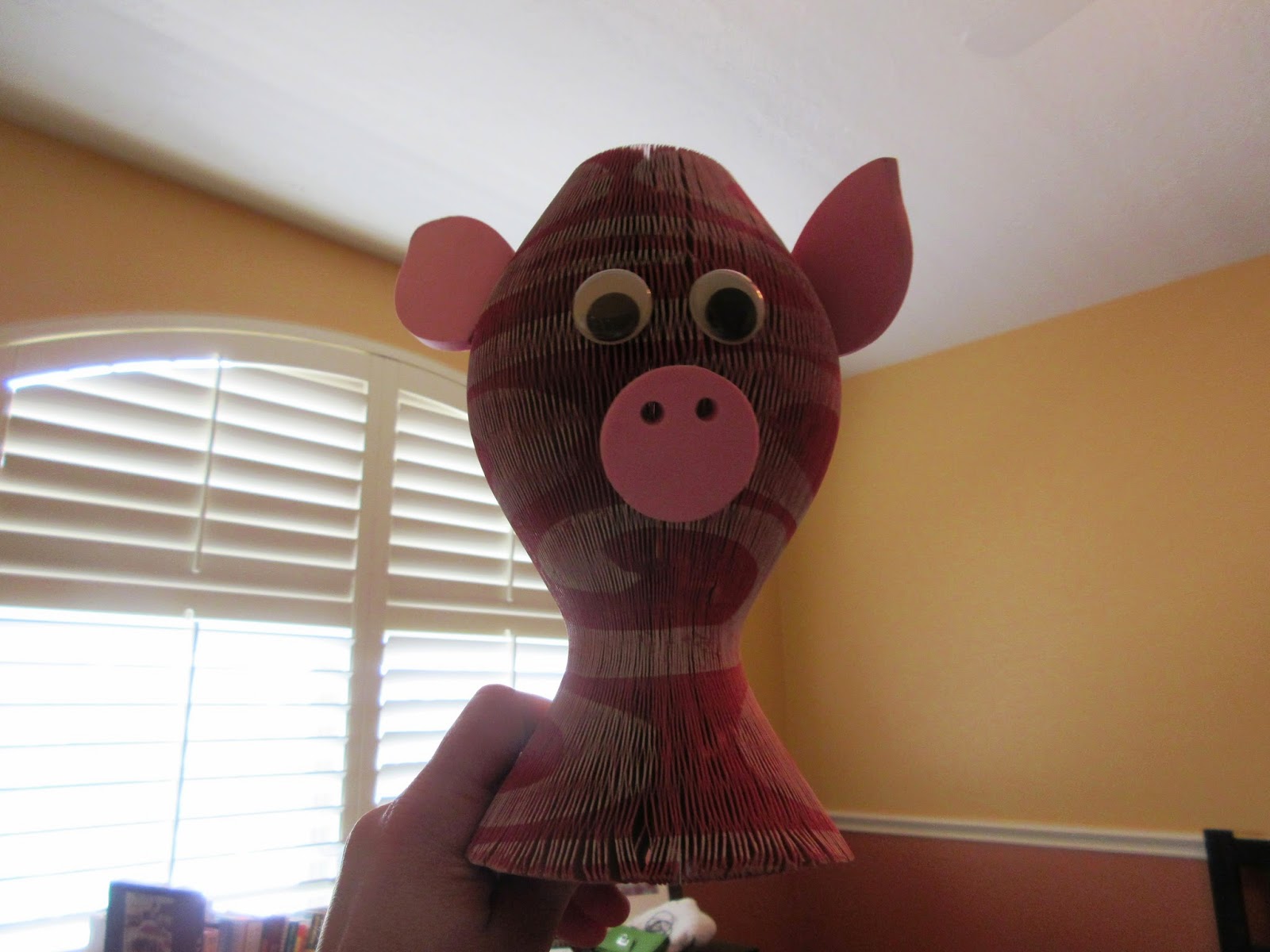
This amazing pig...
that turns into a hat!

Items from our dress up box - feather-covered hats, gypsy skirts, my Grandma´s blouse, and a Lamb Chop puppet!  

These gems. Bought exclusively for the dress up box. They´ve been worn by dozens of people and never washed
(mostly because we didn´t want to damage the fabulousness!) 

These childhood memories are silly and fun; I was a free spirit who loved myself and my friends and my parents were super cool and smart. Little did I know that seven straight years of awkwardness were in store for me in middle school and high school. Those photos, and teenage angst, coming next.